


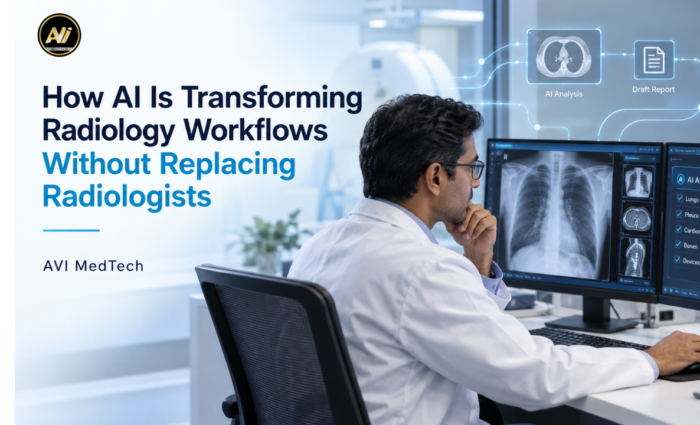
Healthcare is undergoing a significant digital transformation. Artificial Intelligence (AI) is no longer viewed only as a future concept; it is increasingly being explored and adopted across various healthcare operations. Radiology is one field where AI and digital reporting technologies can support workflow efficiency, documentation consistency and clinical productivity.
Despite these developments, one important question continues to arise.
Will AI Replace Radiologists?
AI is unlikely to replace radiologists. Instead, it is expected to support them by reducing repetitive work and improving the efficiency of selected reporting and workflow-related tasks.
AI systems may process large amounts of information and identify specific patterns. However, radiologists remain responsible for interpreting medical images, reviewing patient information, evaluating complex findings and authorizing the final clinical report.
Therefore, AI should be viewed as a support tool for radiologists not as a replacement for their medical knowledge, clinical judgment and experience.
The Growing Demand for Faster Diagnostic Reporting
Hospitals, diagnostic centres and imaging facilities are managing an increasing number of patients while also being expected to deliver clear and timely diagnostic reports.
Traditional reporting methods may involve repetitive typing, inconsistent report formats, manual documentation and disconnected operational activities. Consequently, these challenges can increase the administrative workload and delay the preparation and sharing of reports.
Digital reporting tools are helping healthcare organisations address these challenges by simplifying documentation, organising reporting activities and connecting different stages of the diagnostic workflow.
Depending on the system and its capabilities, modern radiology technologies may support healthcare professionals through:
- Voice-to-text documentation
- Customisable structured reporting templates
- Workflow organisation
- Automated administrative tasks
- Standardised report formats
- Patient history management
- Previous-report comparison
- Digital report storage and sharing
By reducing repetitive documentation, these tools allow radiologists to dedicate more time to image interpretation, complex cases and patient-specific clinical decisions.
Why Structured Reporting Matters More Than Ever
Why Structured Reporting Matters More Than Ever
Structured reporting uses organised, examination-specific templates to document medical findings in a clear and consistent format.
Instead of creating every report from the beginning, radiologists can record observations under predefined sections and modify the content according to the individual case. This makes reporting more organised while preserving the flexibility required for clinical documentation.
Organised Reporting Without Losing Flexibility
Examination-specific templates provide a consistent reporting structure while allowing radiologists to modify findings and impressions according to each individual case.
Primary Benefits of Structured Reporting
- ✓ Clear and well-organised reports
- ✓ Improved communication with referring physicians
- ✓ Reduced documentation inconsistencies
- ✓ Faster report preparation
- ✓ Easier comparison with previous reports
- ✓ Consistent formats across examinations
- ✓ Better organisation of clinical information
- ✓ Reduced repetitive typing
The radiologist remains in complete control. Structured reporting does not replace clinical expertise. The concerned doctor can review, modify and authorise the findings and impression before the report is finalised.
How AI and Digital Tools Can Support Radiologists
AI provides the greatest value when it is used as part of a carefully managed clinical workflow.
Depending on the technology being used, AI-assisted systems may help organise information, automate selected tasks or support documentation. However, their output must still be reviewed within the appropriate clinical context.
Similarly, digital reporting software can connect patient registration, reporting templates, medical images, billing, report authorization and digital sharing within one organised workflow.
As a result, radiologists and diagnostic teams can spend less time managing repetitive administrative work and more time concentrating on essential clinical responsibilities.
Reducing Documentation Burden and Physician Burnout
Repetitive documentation and administrative work can contribute significantly to physician workload and burnout.
Radiologists may spend considerable time entering repeated findings, correcting report formatting, searching for previous reports and completing administrative tasks. Over time, these responsibilities can affect productivity and increase workplace stress.
Digital and AI-assisted reporting tools can reduce this burden by simplifying repetitive tasks while keeping the radiologist in control of the final report.
This can result in:
- Improved productivity
- Reduced repetitive work
- Faster report preparation
- Better workflow organisation
- More time for complex cases
- Greater focus on patient care
Technology should make clinical work easier without interfering with the doctor’s authority over medical findings and final decisions.
Why Human Expertise Remains Essential
Medical image interpretation involves much more than identifying patterns in an X-ray, ultrasound, CT scan or MRI study.
Before arriving at a clinical conclusion, radiologists may consider the patient’s medical history, symptoms, previous imaging studies, laboratory results and other relevant clinical information. They also rely on years of education, practical experience and professional judgment.
Although AI can process large amounts of data quickly, it cannot independently replace:
- Clinical reasoning
- Medical judgment
- Ethical decision-making
- Patient-specific interpretation
- Understanding of the complete clinical context
- Communication with referring physicians
- Multidisciplinary collaboration
- Responsibility for the final diagnosis and report
Therefore, the knowledge and experience of qualified radiologists remain essential. Technology can support their work, but it cannot replace the human judgment required for responsible clinical decision-making.
Building Smarter Radiology Departments
The future of radiology is likely to involve a combination of professional expertise and carefully selected digital technologies.
Hospitals and diagnostic centres are increasingly adopting solutions that simplify reporting activities, improve collaboration and create more connected workflows.
These technologies may include:
- Structured reporting software
- Secure digital reporting systems
- Voice-to-text documentation
- AI-assisted tools
- Workflow automation
- Patient and study management
- Digital report authorization
- Secure report sharing
- Multi-user and multi-centre access
When implemented appropriately, these solutions can help imaging facilities prepare reports more efficiently, maintain consistent documentation and manage diagnostic operations in a more organised manner.
How AVI MedTech Supports Modern Radiology Workflows
AVI MedTech develops practical radiology reporting solutions for radiologists, sonologists, diagnostic centres and healthcare organisations.
Our Radiology Reporting Software connects important reporting and operational activities within one organised system. Depending on the requirements of the facility, the software can support:
How AVI MedTech Supports Modern Radiology Workflows
AVI MedTech develops practical radiology reporting solutions for radiologists, sonologists, diagnostic centres and healthcare organisations.
Our Radiology Reporting Software connects important reporting and operational activities within one organised system.
Depending on the requirements of the facility, the software can support:
- Patient registration and history management
- Customisable examination-specific templates
- Structured reporting for different diagnostic studies
- Voice-to-text documentation
- Quick findings and impression selection
- Medical image upload and management
- Previous-report comparison
- Report review and authorisation
- Digital signature support
- Printing and downloading of reports
- WhatsApp, email and QR-based report sharing
- Appointment scheduling and billing
- Role-based user permissions
- Multi-user and multi-centre operations
- Operational and financial dashboards
- Secure digital record management
- Online and offline workflow support
Radiologists maintain complete control over the findings, impression, review and final authorisation of every report.
Radiologists can review and modify the findings and impression before authorizing a report. In this way, the software supports documentation efficiency while ensuring that the concerned doctor maintains complete control over the final clinical report.
Additionally, the software can be configured according to the examinations, reporting templates and workflow requirements of the diagnostic centre. AVI MedTech also provides assistance with initial setup, template configuration and user onboarding.
Looking Ahead
Artificial Intelligence and digital reporting technologies are changing the way radiology departments manage documentation and operational workflows. However, their purpose is to support healthcare professionals not replace them.
The future of radiology is not a choice between radiologists and technology. Instead, it involves combining medical expertise with practical digital tools that reduce repetitive work, improve documentation consistency and create more efficient reporting workflows.
Healthcare organisations that adopt technology responsibly can enable radiologists to focus on what matters most interpreting medical images, making informed clinical decisions and supporting better patient outcomes.
Looking to Modernise Your Radiology Workflow?
AVI MedTech Radiology Reporting Software helps hospitals, diagnostic centres and imaging facilities organise patient information, prepare structured reports, manage billing, authorize completed reports and share them digitally through one connected system.
Our solution supports customisable reporting templates, voice-to-text documentation, medical image management, previous-report comparison, role-based access, multi-user operations and secure report sharing.
Want to understand how AVI MedTech can support your diagnostic centre’s reporting workflow?
Request a free software demonstration and explore a solution that can be configured according to your examinations, templates and operational requirements
Book Your Free Demo :
Call on : +91-9718054212
Book on : www.avimedtech.com