


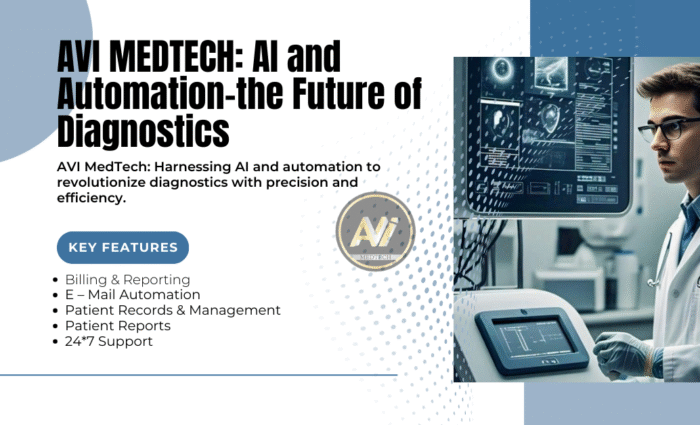
AVI MEDTECH: AI and Automation-the Future of Diagnostics
As AI and automation rapidly evolve, they are transforming industries, including healthcare. In medical diagnostics, AI-driven software makes diagnosis faster, more accurate, and highly efficient, benefiting both healthcare providers and patients.
AVI MedTech advances healthcare with AI-driven HMS, Radiology, and Ultrasound software, enabling accurate diagnoses, efficient workflows, and better patient care.
What Role Does AI Play in Healthcare Diagnostics?
AI in healthcare uses machine learning, deep learning, and algorithms for diagnostics, enhancing accuracy, efficiency, and clinical decision-making.
AI in Medical Image
One of the most robust applications of AI in healthcare is in the sphere of medical imaging. AI quickly interprets medical images, detecting anomalies with precision, enhancing radiology and diagnostics.
AVI MedTech’s Radiology Software uses AI to detect tumors, fractures, and abnormalities, speeding up diagnostics by flagging suspicious areas for review. Instead of searching for abnormalities, the radiologists may focus on interpreting results through radiology software.
AI in Pathology and Predictive Diagnostics
AI is revolutionizing pathology alongside itself. It has taken assistance to aid pathologists in effectively analyzing tissue samples. AI aids early disease detection, analyzes biopsies, predicts progression, and helps pathologists create precise treatment plans.
Predictive diagnostics: AI does well in the predictive diagnostics category. AVI MedTech’s AI-powered software analyzes medical history and genetics to predict diseases, aiding early diagnosis and proactive treatment.
Decision Support Systems Powered by Artificial Intelligence
AI is also significant in making decisions. AI-driven DSS analyzes clinical data, providing doctors with insights, alerts, and evidence-based guidance for accurate diagnosis and treatment decisions.
AVI MedTech’s Hospital Management Software centralizes patient data with AI, enabling real-time analysis and informed decision-making for healthcare professionals.
Automation in Diagnostic Services
There is another very useful tool that goes hand in hand with AI: automation in diagnostics. While AI processes and analyzes data, automation caters to repetitive tasks, freeing healthcare professionals from burdens and making the system much more efficient.
Automation of Data Input and Entry
The biggest challenge of healthcare diagnostics one would expect is patient data management. The traditional method of entry and management of data consumes much time and invites human error. Automation addresses that by enabling systems to capture, store, and organize patient data without it needing to be done manually.
Most routine administrative tasks are already automated with AVI MedTech’s Clinic Management Software, from scheduling and patient registration to billing. As a result, providers have more time for patient care. Additionally, for diagnostics, automation efficiently manages and organizes medical records, ensuring quick and easy access to relevant information when needed.
Automated Reporting and Documentation
But in reports it is a completely different matter. Automation improves diagnostic workflows starkly in this area. Today all reports are essentially fully written and read. Most of this occurs in time-consuming and error-prone processes. All of this is now automated.
Pre-set templates of AVI MEDTECH ensure that it backfills the required information using automation of reporting for Radiology Software and Ultrasound Reporting Software.It basically means that no time is wasted on report preparation, ensuring consistency and accuracy in diagnostic documentation.
AI and automation in diagnosis relevance
Integration of AI and automation in diagnostic workflow increases the accuracy of the diagnosis. AI analyzes vast medical data, detects subtle abnormalities in radiology and pathology, predicts disease progression, and provides early warnings for timely healthcare intervention.
AVI MedTech has always stayed ahead in these developments. With a strong commitment to AI and automation, it continually invests in improving diagnostics and enhancing patient care worldwide. In this context, reducing the labor force can lead to human errors in data entry and reporting. However, AVI MedTech integrates advanced technology to ensure accurate diagnostic information, ultimately providing better service to patients.
Contributory on Healthcare Providers and Patients Benefits of Health Care Providers
Embracing AI and automation in diagnostics offers numerous benefits for healthcare providers. First and foremost, integrating AI with automation significantly reduces the workload on physicians and medical staff. As a result, AI streamlines routine tasks, freeing up valuable time and supporting decision-making. This allows healthcare providers to focus on what matters most—delivering high-quality patient care.
Moreover, AI and automation speed up diagnostics while improving accuracy. Early diagnosis enables quick treatment decisions, reducing misdiagnosis risks and lowering healthcare costs.
Benefits for Patients
This would mean better and quicker diagnoses and treatments for patients. For instance, early stages of cancer and other complex diseases such as heart diseases can also mean a greater chance of effective treatment and even life.The automated workflows in AVI MedTech’s Hospital Management Software prevent delays from bureaucratic inefficiencies, ensuring every patient receives timely care.
With its inherent predictive powers, AI will make healthcare services customized to suit each individual. Proper care-giving to the patient will be ensured, as the treatment plan will be tailored according to the medical history and genetic disposition of every patient. Consequently, there will be better treatments, good control over chronic diseases, and proactive management in health.
High-quality support in AI-driven diagnostics comes with challenges. First, ensuring quality input data is crucial, as poor data leads to inaccurate diagnoses. Additionally, regularly updating and properly anonymizing health data are essential for successful AI-driven diagnostics.
Another challenge lies in the effort of getting the health provider accustomed to new technologies.AI in diagnostics requires skilled healthcare providers. Collaboration among technologists, clinicians, and developers ensures seamless integration into clinical workflows.
The Future of AI and Automation in Diagnostics
AI’s potential in diagnostics continues to grow, especially as new applications emerge. With AI-driven diagnostics, healthcare providers can perform real-time analysis, personalize treatments, and automate processes, ultimately streamlining workflows and enhancing efficiency.
AVI MedTech has always stayed ahead in these developments. With a strong commitment to AI and automation, it continually invests in improving diagnostics and enhancing patient care worldwide.
Conclusion
AI and automation are transforming the way diagnostics work in healthcare. With this advancement, AVI MedTech’s AI-driven software enhances diagnostics, streamlines reporting, and optimizes healthcare workflows with greater precision and efficiency.Moreover, it essentially involves reducing the time spent on report preparation while ensuring consistency and accuracy in diagnostic documentation.